Linux on DeX now supports the Galaxy S9, Galaxy Tab S5e, and Galaxy Note 8, and hints at upcoming Galaxy Tab S5 support

Linux on DeX now supports the Galaxy S9, Galaxy Tab S5e, and Galaxy Note 8, and hints at upcoming Galaxy Tab S5 support
Samsung DeX turns flagship Samsung Galaxy smartphones and tablets into portable PCs. In its first iteration, released alongside the Galaxy S8, DeX required dedicated hardware in the form of the DeX Station. With the Galaxy Note 9 and Galaxy Tab S4, DeX no longer required a special dock and instead worked with supported USB Type-C to HDMI dongles. (Dockless DeX later made its way over to the Galaxy S9, Galaxy Note 8, and Galaxy S8 with the One UI/Android Pie update.) Samsung has done a good job improving DeX on supported devices, but one of Samsung DeX’s best features—Linux on DeX—was only officially supported on the Galaxy Note 9 and Galaxy Tab S4. Now, the latest Linux on DeX beta update officially adds support for the Galaxy S9/S9+, Galaxy S10/S10+/S10e/S10 5G, and Galaxy Tab S5e.
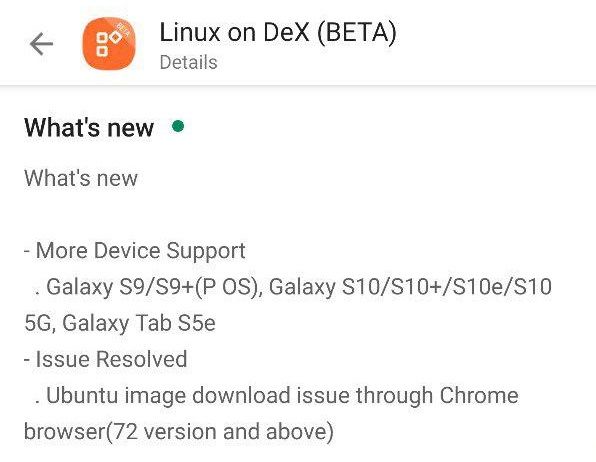
Although the changelog mentions adding support for the Samsung Galaxy S10, Galaxy S10+, Galaxy S10e, and 5G Galaxy S10, as far as I’m aware these devices could already use Linux on DeX so long as you side-loaded the app. Users on Reddit also report that side-loading the latest release works on the Galaxy Note 8, which wasn’t possible on earlier releases of the app.
Support for the Samsung Galaxy Note 8 and…the Galaxy Tab S5?
To confirm which devices Linux on DeX supports, we examined the APK. The latest release lists the following devices as compatible:
- “crown” – Samsung Galaxy Note 9
- “gts4” – Samsung Galaxy Tab S4 and Galaxy Tab S5e (this is not a mistake, the Tab S5e’s code-name is “gts4lv”)
- “gts5” – the unreleased Samsung Galaxy Tab S5
- “star” – the Samsung Galaxy S9 and Galaxy S9+
- “beyond” – the Samsung Galaxy S10, Galaxy S10e, Galaxy S10+, and 5G Galaxy S10
- “winner” – the Samsung Galaxy Fold
- “great” – the Samsung Galaxy Note 8
Note that the method only checks what the device’s code-name starts with, meaning both Exynos and Snapdragon models are included. Sadly, the Samsung Galaxy S8 isn’t on this list. Since the Galaxy Note 8 is included here, that means it’s officially supported even though it hasn’t been whitelisted to download the app from Google Play. If you own a Galaxy Note 8 and want to use Linux on DeX, you’ll need to side-load the 1.0.51 release from APKMirror.

Linux on DeX is a great feature that gives Samsung a leg up on the competition. Although Samsung has yet to implement wireless DeX as Huawei did with Easy Projection, Linux on DeX provides far more functionality than Easy Projection. Linux on DeX lets you run a full GNU/Linux distribution (a modified Ubuntu 16.04 compiled for ARM64) alongside Android. Packages must be compiled for ARM64 to work. It’s for developers and not the average consumer, though, so these limitations are acceptable.
Samsung says you need at least 15GB storage and 4GB RAM to run Linux on DeX, but given that the Galaxy Tab S4 supports it you also need a device with at least the Qualcomm Snapdragon 835 or its equivalent. In our experience using it on the Galaxy Note 9, Linux on DeX works quite well, although it does push the hardware to its limits. It runs even better on the latest Samsung Galaxy S10 series thanks to having more RAM and a better processor. We’re curious why the Galaxy S8 and Galaxy S8+ aren’t supported given that the Galaxy Tab S4 supports Linux on DeX with 4GB RAM and the Qualcomm Snapdragon 835, but perhaps Samsung’s testing showed that Linux on DeX doesn’t perform well enough on the S8/S8+ to justify enabling support for it.
Comments
Post a Comment